Moderating Your Wine Consumption: Choose, Share, Care

Wine is something to be savored—a joy best shared with others, adding color to events, meals, and those rare quiet moments. Yet, as much as we enjoy our wine, there's increasing interest in drinking it thoughtfully, with a focus on pleasure rather than quantity. The European initiative “Wine in Moderation” has become a guiding light here, reminding us that enjoying wine responsibly doesn't mean less enjoyment but, rather, more memorable moments.
On November 8th, "Wine in Moderation" celebrated its second "International Wine in Moderation Day" under the theme, “The Greatest Wine? The One You'll Remember.” It's a simple, powerful reminder: the most unforgettable wines aren't just about what's in the glass; they're about how we experience them. Here's a closer look at the art of balancing pleasure and mindfulness in the world of wine.
Knowing Your Limits—and Loving the Experience
What does “moderation” actually mean when it comes to wine? The “Wine Information Council” (WIC) sheds light on this, suggesting that for most healthy adults, the low-risk range sits at up to two small glasses (200 ml) a day for women and three (300 ml) for men at 12.5% alcohol.
Yet moderation isn't just about quantity; it's also about timing and context. Drinking a glass with food, for example, or staying hydrated with water, can change the experience entirely, making wine an enhancement rather than a detractor from the meal. The WIC also notes that there are times to abstain altogether: during pregnancy, when taking medication, or if you're about to drive or operate machinery.
Wine and Health: The J-Curve and the Mediterranean Lesson
Wine and health have had a complicated relationship in recent years. The “World Health Organization” (WHO) leans toward recommending minimal or no alcohol, while other research, notably the J-Curve, suggests a more balanced view.
This curve essentially shows that moderate wine consumption can reduce the risk factor of certain conditions, including heart disease, strokes, and even type 2 diabetes, in contrast to heavy drinking or complete abstinence.
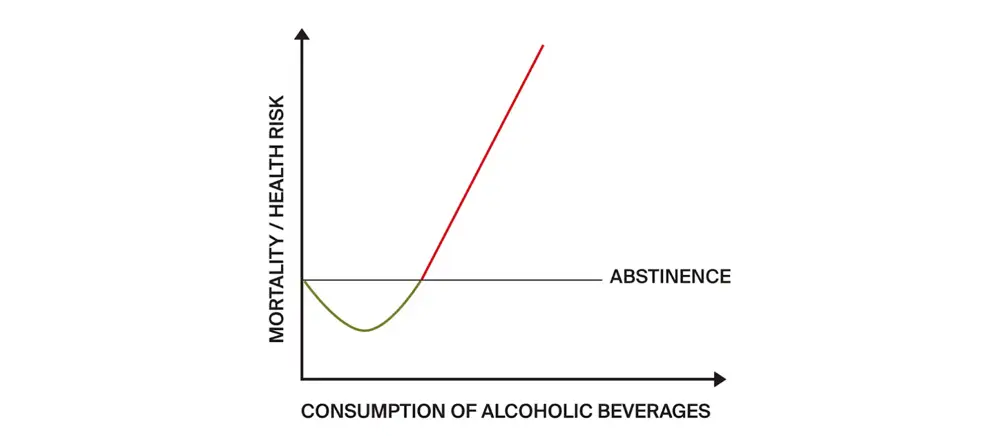
But let's be clear: these benefits are no reason to start drinking if you don't already. Nor are they a hall pass for drinking every day. Instead, they point to an intriguing possibility—namely, that moderate drinking can fit into a healthy lifestyle, especially when part of a Mediterranean approach where wine accompanies food and is enjoyed socially.
On the other hand, regularly exceeding the recommended limits (binge drinking) can have a host of negative effects, from liver issues to cardiovascular problems and beyond. It follows the old saying “less is more”, and holds true with wine as well. With wine, a little goes a long way toward enhancing our lives without taking from our health.
Influencing Calories and Weight
If we're talking “moderation”, one can't ignore calories, even if they're not something we like to think about during a lovely meal. A typical 100 ml pour of dry wine with 12.5% abv will clock in at about 85 calories. For richer wines or fortified sweet options, that number jumps significantly.
Interestingly, moderate red wine consumption, specifically, has been linked to some benefits. Polyphenols—antioxidants found abundantly in red wine—are known to support inflammation control and improve insulin sensitivity, both of which can be helpful for weight management. These polyphenols may also positively influence gut health, which is increasingly seen as crucial to overall wellness.
Still, excessive alcohol in any form generally contributes to weight gain and other health issues. The key lies in the balance and counting the calories on your planned consumption.
Wine Professionals as Stewards of Moderation
Winemakers, sommeliers, and retailers increasingly recognize the importance of advocating for moderation. Many are committed to educating drinkers on how to enjoy wine responsibly, not as a moral obligation but as a way to enrich their experience. When the professionals behind wine stand for moderation, it sets a tone that the entire wine community can follow.
In the end, moderating our wine consumption isn't about saying “no” to pleasure; it's about finding a way to say “yes” to wine as part of a thoughtful, balanced life. When we treat wine as an experience rather than a habit. It's less about having wine at every occasion and more about choosing moments that truly call for it.
Peter Douglas
Member of “Wine in Moderation”